TÉLUQ CGM Research.
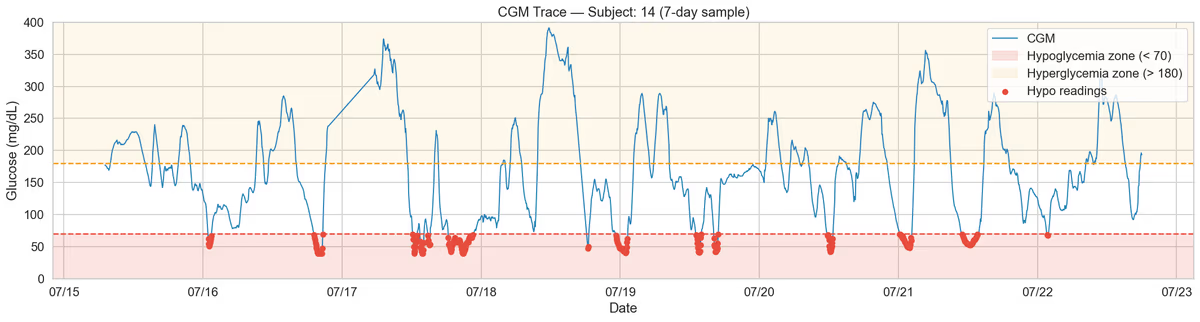
Predicting hypoglycemic episodes from continuous glucose monitoring data, with interpretability as a first-class constraint. SHAP feature attribution surfaced alongside every prediction for clinical decision support.
The constraint that shapes the architecture.
Most CGM prediction work optimises for a single number — sensitivity, specificity, F1 — and reports interpretability as an afterthought. In a clinical setting, that ordering is backwards. A model that predicts a hypoglycemic event 30 minutes ahead with 0.85 F1 is less useful than a 0.78-F1 model whose attributions a clinician can act on.
So we made interpretability a constraint on the architecture, not a post-hoc analysis. Every prediction surfaces a SHAP-style attribution over the 60-minute window leading up to the prediction horizon, indexed by feature: glucose trajectory shape, time-since-meal, recent insulin dose, and circadian phase.
Method.
A transformer encoder over a 60-minute lookback window, with 30-minute forecast horizon. Features are pre-engineered (we don't feed raw 1-minute readings) because the clinical reviewer needs the attribution axes to be readable. The output head is a binary hypo/no-hypo classifier; SHAP runs in a second pass at inference time.
The training set is a long-term CGM cohort from the partner hospital, de-identified per IRB protocol. We evaluate on the clinician's actionability — whether a board-certified diabetologist would change a recommendation based on the prediction and its attribution — alongside standard discrimination metrics.
Where it stands.
Paper drafting is in progress for end of Q3 2026. The institutional partner is TÉLUQ Université, Quebec. The repository is private until publication.
Outcome.
Authors.
- Yacine Dait DehaneESI Sidi Bel Abbès · TÉLUQ
The harness teaches you what the model is doing. Build it first; the rest is implementation.